The fields
One field at a time, in the order you meet them
This is the reference half of the site, and it follows the order you meet things from link to order page. Each field is named the way it appears in the KameyMall interface, so you can match it against the page in front of you rather than a paraphrase. Where the official wording and the official screenshots disagree, both readings are shown.
The price, and the link that admits it moves
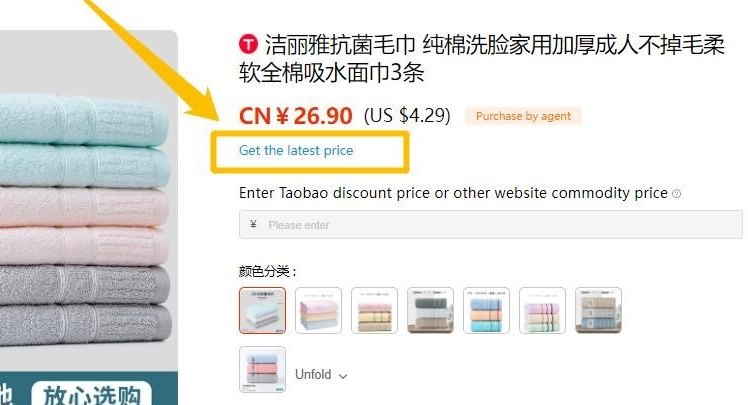
Under the price sits a small link: Get the latest price. The official tutorial explains why it is there. China runs shopping festivals such as Double Eleven, Double Twelve and 6.18, and prices on those days differ from the usual ones, so the page gives you a way to re-read the seller price on demand rather than showing you a cached one.
Just below it there is a second box, the one for entering a Taobao discount price or another website's commodity price. That one is yours: it exists for the case where you found the same listing cheaper somewhere else. The two official screenshots word its label slightly differently, which is worth knowing before you go looking for an exact phrase.
And at the bottom of the order page, in brackets, the sentence that ties the whole thing together: due to the price fluctuation, you may be required to pay the balance due after submitting the order. The status list calls that state Balance Pending.
Domestic freight is a second price
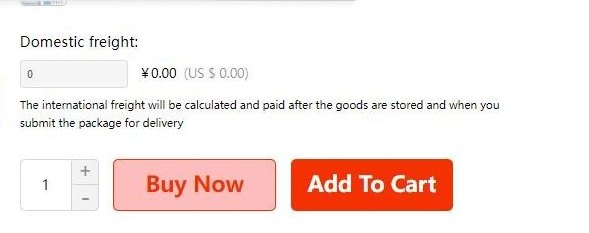
On the product page, Domestic freight sits in its own box with its own value, separate from the item price. It covers moving the item inside China to the KameyMall warehouse, and it belongs to the seller.
The line under it states the other half plainly: the international freight will be calculated and paid after the goods are stored and when you submit the package for delivery. So at the moment you are looking at a find, one shipping cost is visible and the larger one does not exist yet.
This is also why a cheap item is not always a cheap order. Official first-use guidance suggests estimating the international shipping before placing the order, and the two-payment structure is described there as well.
鞋码 and 颜色分类, and the advice hidden inside an option
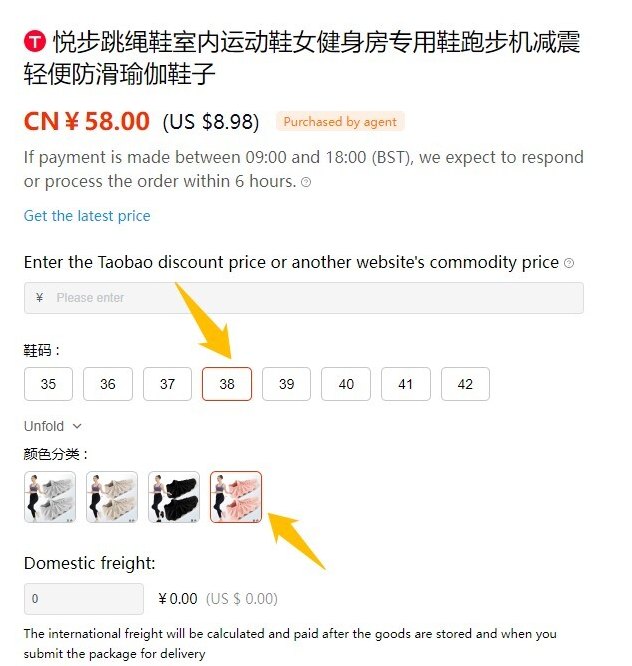
The specification block is where beginners lose the most time. In the official screenshots the labels are Chinese: 鞋码 for shoe size and 颜色分类 for colour category. The values under them are the seller's own list, not a standard one.
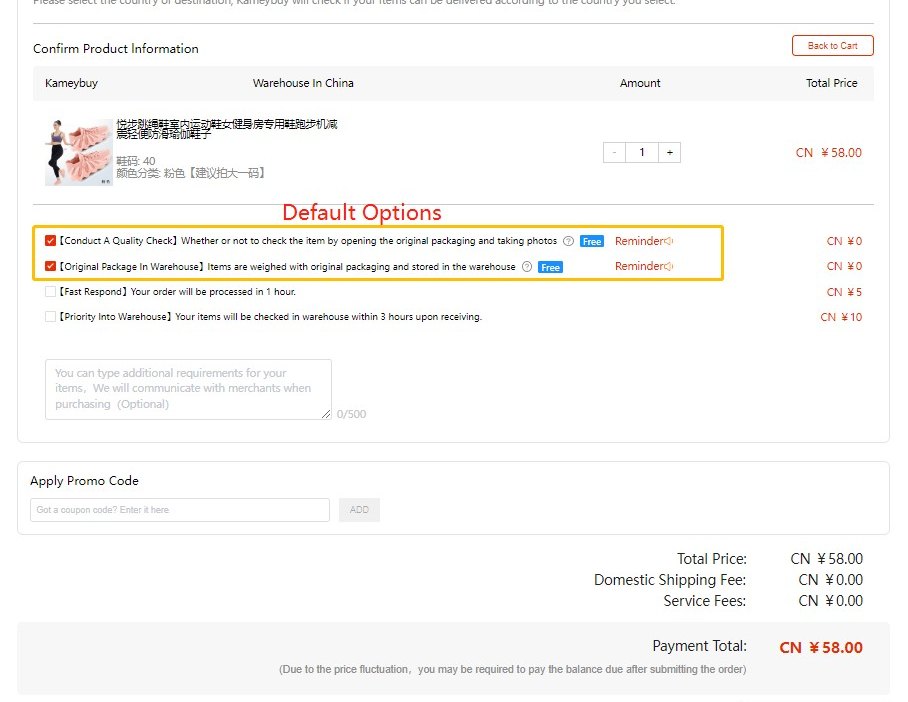
One order-page screenshot goes further and shows the selected colour as 粉色【建议拍大一码】. That reads as pink, followed by the seller suggesting you order one size larger. The advice is inside the option name, so anyone scanning for a colour swatch will scroll straight past it.
Two readings, both from KameyMall. The official tutorial says that in the module of product specification, colours and sizes are translated for you. The official screenshots show them in Chinese. We are not going to tell you which one is current, because both come from the same company and the interface has been redesigned since those screenshots were taken. Check the page actually in front of you, and if the label is Chinese, copy it into a translator before choosing.
Sizing, using KameyMall's own size page
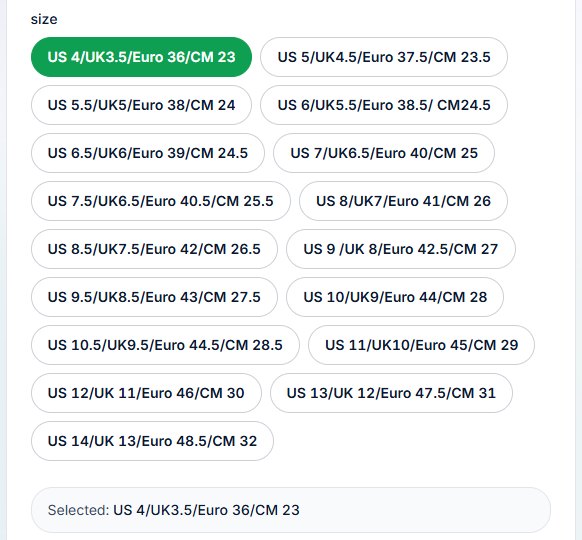
The official How to Choose the Right Size page is more useful than most agent size guides, and it is the source for everything in this table. It also ends with a line worth keeping in mind: the information is for reference only and is not enforced by law.
| What you see | How to read it | The catch |
|---|---|---|
| 160/68A on a clothing tag | 160 is height in centimetres, 68 is bust or waist, and the letter is body type: Y smaller than average, A normal, B larger, C extra large. | Standards vary between Taobao stores. The official advice is to use your own measurements rather than the letter. |
| 29W x 30L on jeans | A 29 inch waist and a 30 inch inseam, measured crotch to hem. One inch is 2.54 centimetres. | Trouser length also comes as S, R and L for shorter, regular and longer than standard. |
| A shoe size number | Measure in the afternoon, when feet are largest, and use your bigger foot. | Chinese shoe sizing does not describe width. The official guidance for wider feet is to go up half a size. |
| Your own tape measure | Keep the tape straight and wrap it loosely. | The official page allows 1 to 3 centimetres of difference for manual measurement, which is often the whole gap between two sizes. |
The four service options, and the two that are already ticked
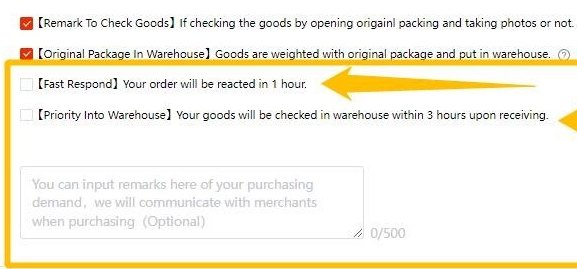
The order page carries four options. The official screenshot labels the first two Free and shows them ticked by default, with red text calling them Default Options, and shows CN¥5 and CN¥10 against the other two. Those amounts are the operator's interface values from the 2023 tutorial, so treat them as an illustration of the structure rather than today's price list.
The pair worth pausing on is the free pair. Conduct A Quality Check means opening the original packaging to photograph the item. Original Package In Warehouse means weighing and storing it with the packaging intact. Both are on by default, and they pull in opposite directions, so it is worth deciding which one this particular item needs.
The 500-character box is the only place you can say something new
Under the options sits a text box. The official tutorial's own screenshots word its placeholder two ways, you can type additional requirements for your items in one and you can input remarks here of your purchasing demand in another, but both finish the same way: we will communicate with merchants when purchasing. Both are marked Optional, and the counter in the corner caps it at 500 characters.
It is also the only field on the whole order that is not a dropdown. Anything the option lists cannot express has to go here, which makes it the right place for a measurement, a choice between two ambiguous variants, or a request that the seller confirm stock before shipping.
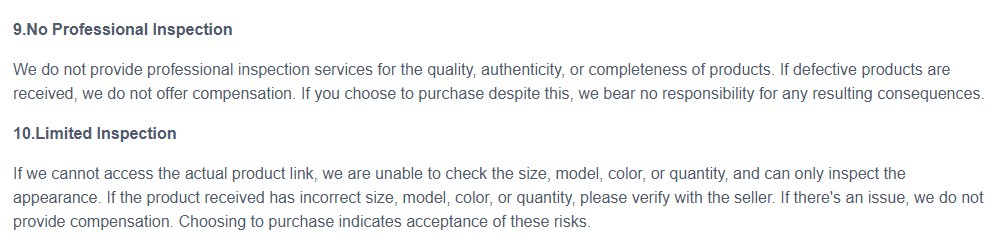
What it cannot do is create a check that does not exist. Asking for the item to be verified as genuine, or only sent if the quality is good, runs straight into the official disclaimer that no professional inspection is provided for quality, authenticity or completeness. The buyer can pass a question to the seller. They cannot test the thing.
Reading the QC photos against the clauses that limit them
Shopping groups call the warehouse photographs a QC. KameyMall never uses that word in its help centre; it calls the stage inspection, and it has published two clauses saying what that inspection is not. Read the photographs with those two clauses open and the set gets much easier to judge, because you stop asking it questions it was never going to answer.
Start from the ceiling, not from the pictures
Clause nine says no professional inspection service is provided for the quality, authenticity or completeness of products. Clause ten says that when the actual product link cannot be accessed, the size, model, colour and quantity cannot be checked either, and only the appearance can be inspected. Whatever the pictures show, those two sentences are the ceiling on what the set is able to settle.
Check the fields that came off your own order
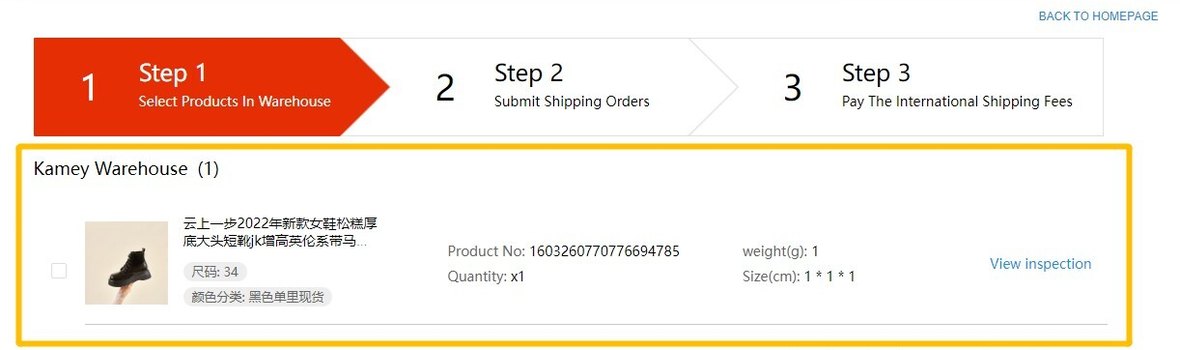
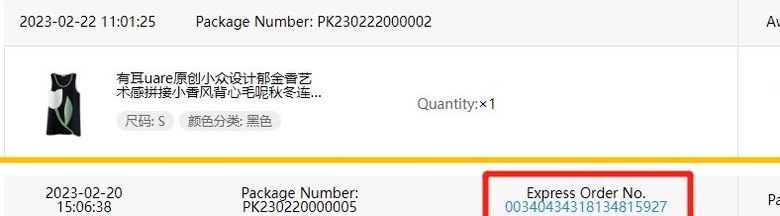
The package row carries a size chip and a colour chip written in Chinese, and a quantity. Those came from options you picked, so comparing them against what you meant to pick is the comparison the photographs can genuinely settle. A mismatch here is worth raising at once, and clause ten is explicit about where it goes: verify with the seller.
Treat the making of the item as out of scope
Stitching, materials, whether a logo is right: none of that is in the inspection as written. Asking for it in the 500-character box does not create it either, since the remark is passed to the merchant rather than to a tester. If that answer matters more than the item does, the honest move is to decide before the order, not after the photographs.
Ask inside the gap between Stored and the shipping order
Stored is the status where the inspection is finished and the parcel is on a shelf. Submitting it for international shipping is a separate step that you trigger. The photographs live in the gap between those two, and that gap is the only stretch where the parcel is both inspected and still in the building.
Read the official pages behind this one
Every claim above comes from one of these. They are worth opening once even if you never come back to them.
 KameyMall official
How to Choose the Right Size
The size tag decoder, the conversion charts and the 1 to 3 centimetre measuring note.
Open the size page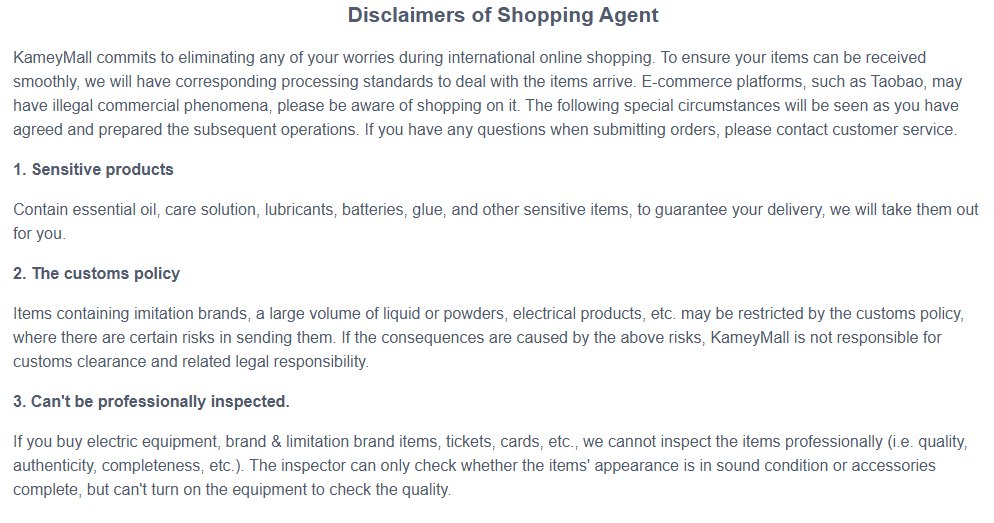 KameyMall official
Disclaimers of Shopping Agent
Ten clauses covering sensitive goods, customs, fragile items, and the limits of the inspection.
Open the disclaimersNext: which of these matters for your category
Not every field matters equally for every item. The category page sorts the sixteen categories by who settles the field most likely to move: you, when you tick the options; the warehouse, once the parcel has been weighed; a clause in the disclaimers; or the carrier.